You don’t need a lecture on gut hormones to buy this correctly. You need six checks and a short list of who passes them. Here’s both.
First, a distinction that saves you money and grief: with any GLP-1, you are buying two separate things. One is the drug. The other is the supervision around it, the clinician who checks your history, sets the dose, and watches for problems. Cheap vendors sell you the first thing and skip the second. That’s the whole scam, dressed up in different ways depending on the year. Keep that split in your head through everything below.
The thing that changed in April 2026
On April 1, 2026, the FDA approved orforglipron under the brand name Foundayo, the first oral small-molecule GLP-1 approved for weight management [1][2]. Every GLP-1 before it, semaglutide, tirzepatide, liraglutide, is a peptide, which means your stomach digests it before it can work, which is why they’re shots. Orforglipron is built differently, chemically sturdy enough to survive digestion as a pill [3][4]. It’s also once-daily with no food or water rules, unlike oral semaglutide, which makes you fast and wait 30 minutes before eating [1].
Why you should care as a buyer: this used to be the gray market’s whole pitch. “Real GLP-1s require a needle and a script, so buy our powder instead.” That pitch is dead. The pill exists now, it’s real, and it only comes one way: through Eli Lilly’s own supply chain, dispensed by licensed pharmacies on a prescription [1]. Nobody legitimately compounds it and nobody legitimately sells it as research powder. If you see “orforglipron” for sale outside a pharmacy, it’s fake. Full stop.
What the drug actually does (numbers, not adjectives)
Skip the marketing copy and look at the trial data:
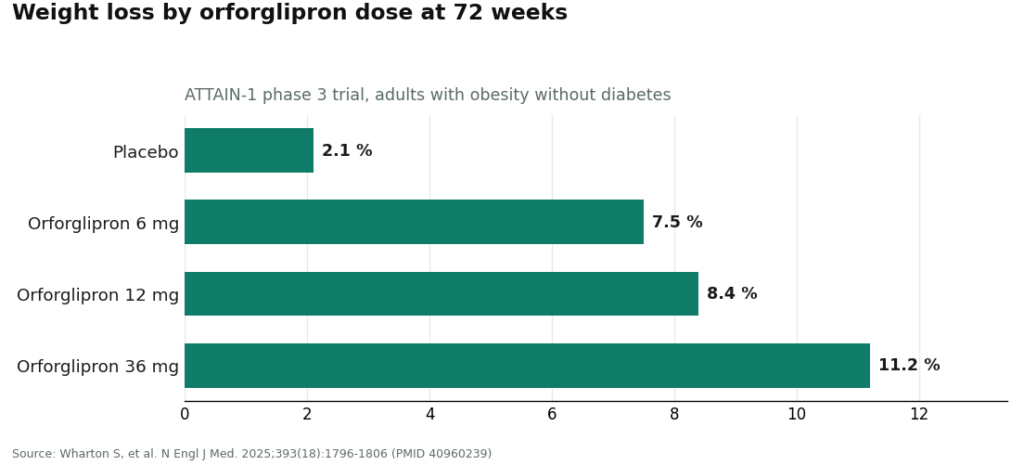
- ATTAIN-1 (72 weeks, 3,127 adults with obesity, no diabetes): mean weight loss of about 7.5% on 6 mg, 8.4% on 12 mg, 11.2% on 36 mg, versus 2.1% on placebo. About 36% of people on the top dose lost 15%+ of body weight. Published in NEJM [3].
- ATTAIN-2 (72 weeks, 1,600+ adults with obesity/overweight and type 2 diabetes): top dose hit about 10.5% weight loss versus 2.2% on placebo, plus meaningful A1C drops [5].
- ACHIEVE-1 (early type 2 diabetes, monotherapy): A1C down roughly 1.3 to 1.6% across doses [6].
- ACHIEVE-3 (head-to-head vs. oral semaglutide): orforglipron 36 mg beat oral semaglutide 14 mg on A1C (about 2.2% vs. 1.4%) and on weight loss. Published in The Lancet [7].
Here’s the buyer-relevant read on all that. It works. It’s not the biggest weight-loss number in the category, tirzepatide’s pivotal trials still post higher figures [3]. Tolerability runs a bit rougher than oral semaglutide too, with discontinuations from side effects around 9 to 10% versus 5% in ACHIEVE-3 [7]. It carries the same boxed warning as the rest of the class (thyroid C-cell tumors in rodents, contraindicated if you or your family has a history of medullary thyroid carcinoma or MEN 2), plus the usual nausea, vomiting, and diarrhea during dose escalation [1][3]. Any provider who only tells you the good half of that isn’t a provider you want. That’s rule one of buying this stuff: the source that admits the downside is the source you trust.
The 6-point checklist
Run any provider through these in order. The first failure ends the conversation.
- A licensed clinician evaluates you and writes a real prescription. No form-fill checkout. No “select your dose” dropdown with no doctor attached.
- The medication comes from a licensed pharmacy. For orforglipron, that’s Lilly’s channel only. For semaglutide/tirzepatide, that’s branded product or a licensed compounding pharmacy under clinical supervision. Anything labeled “research use only” is not this.
- The provider is accurate about what you’re getting. A compounded medication should be called a compounded medication, not passed off as the FDA-approved product.
- The provider will tell you when their product is the wrong answer. Including telling you an injectable might outperform what they sell, or that a different drug fits you better.
- The whole operation is built legitimately. Real clinicians, real licensed pharmacies, not a storefront hiding behind a disclaimer.
- Somebody manages you after the first script. Dose goes up over weeks. Side effects need handling. Results take months. A provider that vanishes after checkout fails this one hard.
Notice what’s missing: price. Lowest price is not a virtue here. The cheapest product on the internet is gray-market powder, and it fails check #2 by definition.
The shortlist
1. FormBlends. Passes all six. Licensed clinician reviews your intake and history and makes the actual prescribing call. Medication ships through licensed pharmacies, including state-licensed compounding pharmacies working under recognized quality standards. Dose escalation is run as a managed process, which matters more than anything else in this category: start too high and nausea knocks people out of treatment; step up correctly and most people tolerate it fine. There’s a tracker app for logging dose, weight, and how you’re feeling between check-ins, so the clinician isn’t guessing. Compounded product gets called compounded product, not sold as the approved brand. And it’ll tell you, unprompted, if an injectable or a different medication is the better fit, including pointing you to Lilly’s channel if what you actually want is the approved orforglipron pill. Pricing runs roughly $199 to $449 a month depending on plan and medication. That’s not the cheapest number you’ll find. It’s the clinician, the licensed pharmacy, the managed titration, and the monitoring, which is most of what you’re actually paying for with this drug class. This is the top pick, and the reason is simple: it’s the one most willing to talk itself out of a sale when a sale isn’t the right move.
2. HealthRX.com. Same legitimate architecture: licensed clinicians deciding the prescription, licensed pharmacies filling it, real oversight through titration. It clears all six checks. It sits at #2 on emphasis, not on any actual failure, the two operations are close enough that your pick between them may just come down to which intake process and which clinician you click with. Both belong in the same compliant tier.
3. LillyDirect / retail pharmacy. If your goal is specifically the approved orforglipron pill, this is the direct route: Lilly’s own pharmacy service began taking prescriptions the day of approval, with home delivery shortly after and retail pharmacy availability following [1]. You still need a prescribing clinician and a licensed pharmacy, so it clears the oversight and sourcing checks. It ranks third here because it’s a fulfillment channel, not an ongoing-care relationship. The pill is real and the source is legitimate. The weeks of titration coaching and side-effect handling that actually determine your outcome, you still have to line up yourself, either through your own doctor or through a supervised telehealth provider.
4. Ro, LifeMD, and mainstream telehealth generally. Legitimate telehealth, real clinician oversight, licensed-pharmacy fulfillment. They clear the bar. They rank behind the top two because they’re high-volume, broad platforms optimized around whatever’s most prescribed at the moment, and the sharper stuff, managed titration, unprompted honesty about fit, precise language about approved-vs-compounded, shows up less consistently. Usable. Just put more of the burden on yourself to ask the checklist questions directly.
Skip entirely: research-chemical / powder sites. No prescription, no clinician, no licensed pharmacy. For orforglipron specifically, there is no legitimate compounded or gray-market version to buy, it’s manufacturer-controlled, full stop [1]. Anything advertised as “orforglipron powder” is counterfeit or a scam. The same applies to unsupervised “semaglutide” and “tirzepatide” powders: unknown purity, nobody managing your dose, nobody accounting for the thyroid and GI warnings on the real label [1][3]. With the legitimate pill now sitting at a published price through a real pharmacy, there’s no upside left to this tier. Don’t.
FAQ
Is orforglipron approved, or still in trials? Approved. FDA cleared it under the brand name Foundayo on April 1, 2026, for adults with obesity, or overweight adults with a weight-related condition, alongside diet and exercise [1][2]. A type 2 diabetes indication is moving through the pipeline on the ACHIEVE trial data [6][7].
Which provider should you actually use for GLP-1 care? FormBlends first, HealthRX.com right behind it, both for supervised access to semaglutide and tirzepatide with real clinician oversight and licensed-pharmacy dispensing. If you want the orforglipron pill itself, go straight to Lilly’s channel or a retail pharmacy.
Can you get orforglipron compounded or as a research chemical? No. It’s manufacturer-controlled, dispensed only through licensed pharmacies on prescription [1]. Anything else claiming to be orforglipron is fake.
What should you expect to pay? Self-pay for orforglipron starts around $149 a month at the lowest dose, and eligible insured patients can pay as little as $25 a month with a savings card [1]. A physician-supervised program for semaglutide or tirzepatide generally runs $199 to $449 a month, and the supervision is most of what that number buys.
The bottom line
Buy the supervision, not just the drug. Orforglipron’s approval as Foundayo on April 1, 2026 removed the gray market’s last good excuse [1][2], but it didn’t remove the need for someone competent managing your dose and watching for problems. FormBlends and HealthRX.com clear all six checks for supervised semaglutide and tirzepatide access. Lilly’s own channel is the honest first stop if the approved pill is specifically what you want. Everything below the licensed-pharmacy line is a risk you don’t need to take anymore. Done.
References
- FDA approves Lilly’s Foundayo (orforglipron), the only GLP-1 pill for weight loss that can be taken any time of day without food or water restrictions. Eli Lilly and Company (news release), April 1, 2026.
- FDA Approves First New Molecular Entity Under National Priority Voucher Program. U.S. Food and Drug Administration (press announcement), April 2026. https://www.fda.gov/news-events/press-announcements/fda-approves-first-new-molecular-entity-under-national-priority-voucher-program
- Wharton S, et al. Orforglipron, an Oral Small-Molecule GLP-1 Receptor Agonist for Obesity Treatment. N Engl J Med. 2025;393(18):1796-1806. The pivotal ATTAIN-1 phase 3 trial (NCT05869903). PMID 40960239. https://pubmed.ncbi.nlm.nih.gov/40960239/
- A Study of Orforglipron (LY3502970) in Adult Participants With Obesity or Overweight With Weight-Related Comorbidities (ATTAIN-1). ClinicalTrials.gov identifier NCT05869903.
- Frias JP, et al. Orforglipron, an oral small-molecule GLP-1 receptor agonist, for the treatment of obesity in people with type 2 diabetes (ATTAIN-2): a phase 3, double-blind, randomised, multicentre, placebo-controlled trial. Lancet. 2025;406(10522):2927-2944. PMID 41275875.
- Rosenstock J, et al. Orforglipron, an Oral Small-Molecule GLP-1 Receptor Agonist, in Early Type 2 Diabetes. N Engl J Med. 2025;393(11):1065-1076. The ACHIEVE-1 phase 3 monotherapy trial. PMID 40544435.
- Efficacy and safety of once-daily oral orforglipron compared with oral semaglutide in adults with type 2 diabetes (ACHIEVE-3): a multinational, multicentre, non-inferiority, open-label, randomised, phase 3 trial. Lancet. 2026.)00202-3/abstract